
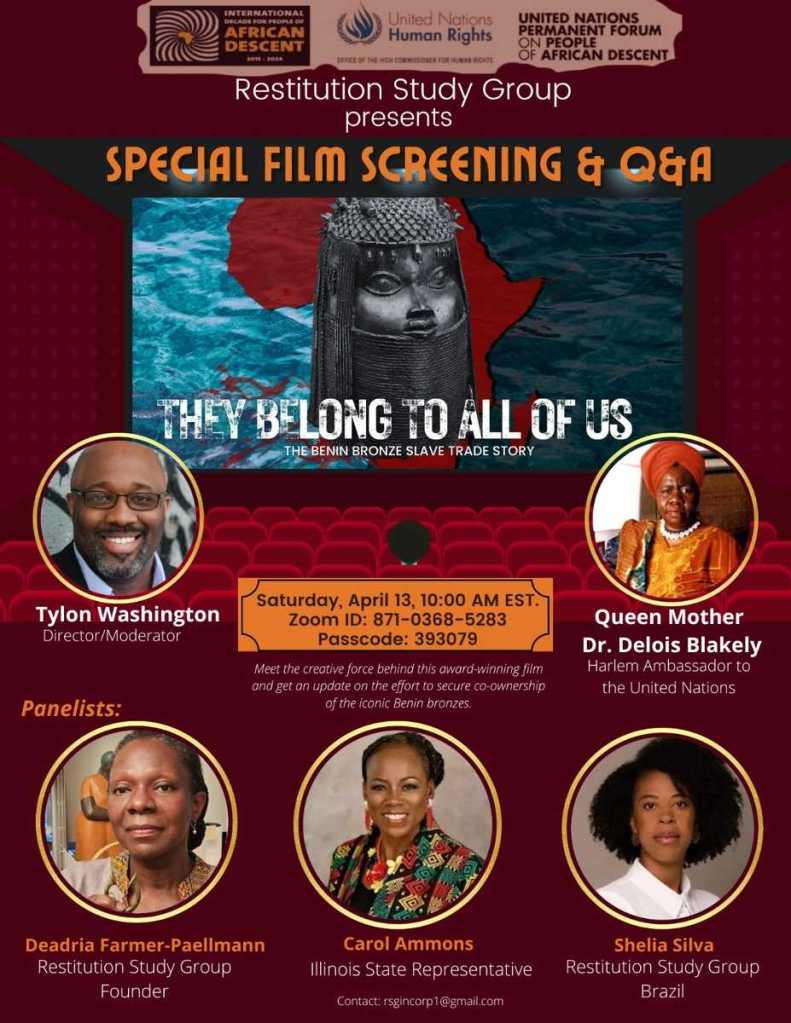
GENEVA, SWITZERLAND – At an official side event of the United Nations Human Rights Commission’s Permanent Forum on People of African Descent, on Saturday April 13, 2024, at 10 am ET, global descendants of enslaved Africans forcefully stated their ownership claim to the famous Benin Bronzes through the Restitution Study Group (RSG). The event featured a screening of the new director’s cut of the 2023 Cannes Award-winning short film “They Belong to All of Us: The Benin Bronze Slave Trade Story.” The film includes new footage from the global campaign for the Afrodescendant interest in and rights to the iconic relics and recognition by descendants of Benin kingdom captives.
The program opened with a prayer poem from Queen Mother Dr. Delois Blakely, Harlem, New York’s Ambassador to the United Nations: “Oh God, that name greater than ourselves…we behold in the spirit of our ancestors. That life. We with the terrific. Pain of horror. And it’s left with us to this day.”
RSG’s Executive Director Deadria Farmer-Paellmann revealed that she and other panelists have DNA linking them to the once-powerful Benin Kingdom in modern Nigeria. “Most of us are literally from the Benin Kingdom, which means these bronzes belong to us on more than one level. Many of us descend from the Edo women the Benin kingdom admits to exclusively enslaving for 150 years,” she stated.
The 16th to 19th century brass bronzes were cast using “manillas” – brass currency paid to the Benin Kingdom for captured Africans sold into the transatlantic slave trade. Today, as many as 10,000 bronzes exist and are worth as much as $30 billion. “Our ancestors paid for them with their lives and we pay for them with our suffering today,” said Farmer-Paellmann. “Yet our connection has been ignored for over a century by museums who still refuse to include the slave trade origin of the brass relics in exhibit captions.”
She explained that some museums, like the Smithsonian Institution, German and British museums, are gifting the slave trade bronzes to slave trader heirs from the Benin kingdom — they get to benefit twice from their ancestors’ crime against humanity.
Tylon Washington, Director of the screened film, expressed shock over learning this history: “I used to see the bronzes, but had no idea of this history” he said. This same sentiment was shared by other panelists.
British reparations movement leader (RSG UK/Caribbean Mobilzer), Esther Xosei, is depicted in the film outside the Horniman Museum in London: “I grew up blocks away from the Horniman Museum and visited often. I never knew my connection to these bronzes until now. The museum exhibit captions still do not reveal the slave trade origin,” she said.
Illinois State Representative Carol Ammons has joined RSG’s effort and last month took fellow Black legislators to view the largest Benin Bronze collection in the United States, at Chicago’s Field Museum. “The museum director said he had never gotten such a request from African Americans,” Ammons stated. “Because you have these artifacts that actually belong to our people, you have a responsibility to allow our people access to them. And we must get a seat at the table to manage these relics and change the narratives to tell our side of the story.”
RSG Brazil/Germany Mobilizer Sheila Camarotti highlighted the continued struggle of Afro-descendants in her home country of Brazil. “Slavery ended in 1888 in Brazil. It started with the Portuguese doing business with royal families like the Benin kingdom. Today we still practice African religion and are discriminated against for doing so. Afrodescendants are still suffering from the vestiges of slavery. Many people are homeless, living in the streets of Brazil,” she said.
Queen Mother Blakely emphasized, “We must get our share of the bronzes and they must not be returned to the Benin Kingdom. We need healing dialogue, reconciliation, because we share this cultural heritage.”
Farmer-Paellmann views this as “an opportunity for the Oba to bring his kingdom back together and build a franchise to educate and heal. He should lead.” Toward that goal, she announced the founding of the Harlem based “Benin Kingdom Museum,” and called on the public to visit their website, www.theBKM.org, to give comment and financial support toward the development of the global franchise.
RSG cites legal precedents, including a New York State law mandating museums to identify looted artworks from the Holocaust era by citing the provenance in museum captions. It also highlighted that a British museum repatriated cultural artifacts to a forcibly displaced Australian aboriginal group last year.
Rep. Ammons requested a copy of the Holocaust museum law to introduce in the state of Illinois for Benin bronze transparency.
When the Bronzes were taken in 1897 by British forces, it ended the centuries-old practice by the Benin Kingdom of using enslaved persons as human sacrifices. Farmer-Paellmann argued, “By working together openly, the Benin Kingdom and we Afrodescendants can finally begin healing dialogue. But the museums must respect our equal status in this matter and include us all at the table.”
“Farmer-Paellmann has called on the UN PFPAF to enact a protocol to ensure that nations and global museums conduct provenance research beyond the colonial era and include the slave trade origin of African artifacts before repatriation. Slave trade derived relics must remain where Afrodescendants reside so that they have full access to their cultural heritage,” she says.
About Restitution Study Group:
The Restitution Study Group is a NYC-based non-profit dedicated to advocating for reparatory justice related to the trans-Atlantic slave trade and its continuing impacts. Learn more at: www.rsgincorp.org. Sign our petition at: www.change.org/p/share-the-benin-bronzes.
Screen this side event at below:
###
Contact:
Deadria Farmer-Paellmann, J.D., M.A.
Executive Director
Restitution Study Group
www.rsgincorp.org
917-365-3007
 Restitution Study Group